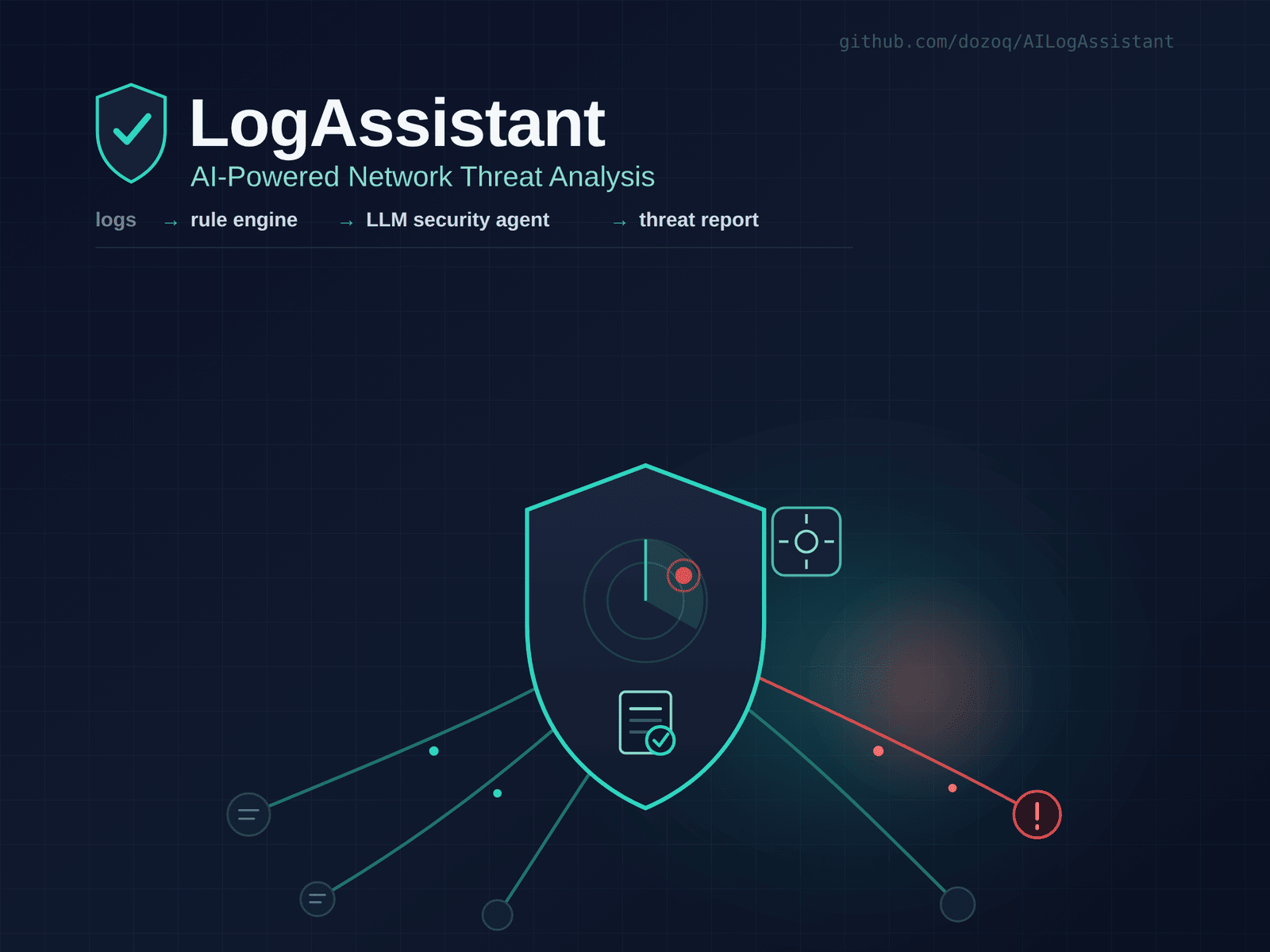
🛡️ LogAssistant — AI-Powered Network Threat Analysis
Upload raw network logs. Get structured, AI-generated threat reports in real time.




What it does
LogAssistant ingests raw network/access logs, runs them through a configurable rule engine (signature + volumetric detection rules), and — when a rule is triggered — hands the suspicious activity off to an LLM security agent that investigates it using real tools (a MITRE ATT&CK knowledge base and IP activity history), then produces a structured threat report: type, severity, mitigation plan, and recommendations. Reports are persisted and broadcast live over WebSocket to a Streamlit dashboard.
It's a small end-to-end system that combines a few things that are individually common but rarely wired together in a portfolio project: rule-based detection, an LLM agent with tool-calling and retrieval, async persistence, machine-to-machine auth, and a real-time frontend — backed by a test suite (unit + integration, ~87% coverage) that mocks the LLM and vector store instead of hitting them for real.
Architecture
flowchart LR
    A[Log file] -->|upload| B["POST /threat-reports/process-batch"]
    B --> C[LogService]
    C --> D["PolicyEngine\n(signature + volumetric rules)"]
    D -->|rule triggered| E["SecurityAgentService\n(LangChain agent, tool-calling)"]
    E -->|tool call| F[("Qdrant\nMITRE ATT&CK KB")]
    E -->|tool call| G[IP activity history]
    E --> H[ThreatReport]
    H --> I[EventDispatcher]
    I --> J[WebSocket broadcast]
    I --> K[(Database)]
    J --> L[Streamlit dashboard]
Batch analysis (/process-batch) is machine-to-machine only, protected by a JWT obtained via an OAuth2 client_credentials flow (/auth/token) — not the usual username/password grant, since there's no human user on that side, only a trusted log-shipping client.
Features
- Configurable rule engine — signature-based and volumetric (rate-based) detection rules, defined in a JSON policy file, validated with Pydantic on load.
- LLM security agent — a LangChain tool-calling agent (Claude) that investigates a triggered rule using a MITRE ATT&CK knowledge base (Qdrant + HuggingFace embeddings) and IP activity history, and returns a structured, schema-validated threat report.
- Machine-to-machine auth — OAuth2
client_credentialsgrant with a JWT, purpose-built for service-to-service calls instead of the more common (and here, wrong) resource-owner password grant. - Real-time alerts — new threat reports are broadcast over WebSocket to a Streamlit dashboard as they're generated.
- Async persistence — SQLAlchemy 2.0 async ORM.
- Structured logging —
structlog, JSON in production / readable console output in development. - Test suite — unit tests for the rule engine, schemas, and services; the LLM and vector store are mocked rather than called for real, so the suite is fast and deterministic.
Tech stack
Backend: FastAPI, LangChain (Anthropic Claude), Qdrant, HuggingFace embeddings, SQLAlchemy (async), Pydantic v2, structlog, PyJWT Frontend: Streamlit, WebSocket client Testing: pytest, pytest-cov, anyio Infra: Docker Compose (backend + frontend + Qdrant)
Quick start
git clone https://github.com/dozoq/AILogAssistant.git
cd AILogAssistant
cp .env.example .env   # fill in the values, see Configuration below
docker compose up --build- Backend API:
http://localhost:8000 - Frontend dashboard:
http://localhost:8080 - Qdrant:
http://localhost:6333
Configuration
| Variable | Used by | Description |
|---|---|---|
ANTHROPIC_API_KEY |
backend | Claude API key for the security agent |
JWT_SECRET_KEY |
backend | Signs/verifies the M2M access tokens |
INTERNAL_CLIENT_SECRET |
backend | Shared secret trusted clients authenticate with |
QDRANT_URL |
backend | Qdrant endpoint (http://qdrant:6333 inside Docker) |
DATABASE_URL |
backend | Optional — defaults to a local SQLite file |
Testing
cd LogAssistant
uv run pytest --cov=src/logassistant --cov-report=term-missing
The suite covers the rule engine (including edge cases like threshold arithmetic and regex targeting), Pydantic schema validation, the auth flow, and the LLM agent's orchestration loop — the agent's ainvoke calls are mocked with canned AIMessage responses, so tests run without live API calls or a running Qdrant instance.
API testing
A Bruno collection is included under bruno/ with example requests for every endpoint.
Project structure
LogAssistant/          FastAPI backend
LogAssistantFrontend/  Streamlit dashboard
bruno/                 API request collection
docker-compose.yaml    Backend + frontend + Qdrant